Resources Centre
CATEGORIES

6G & Wi-Fi Requirements
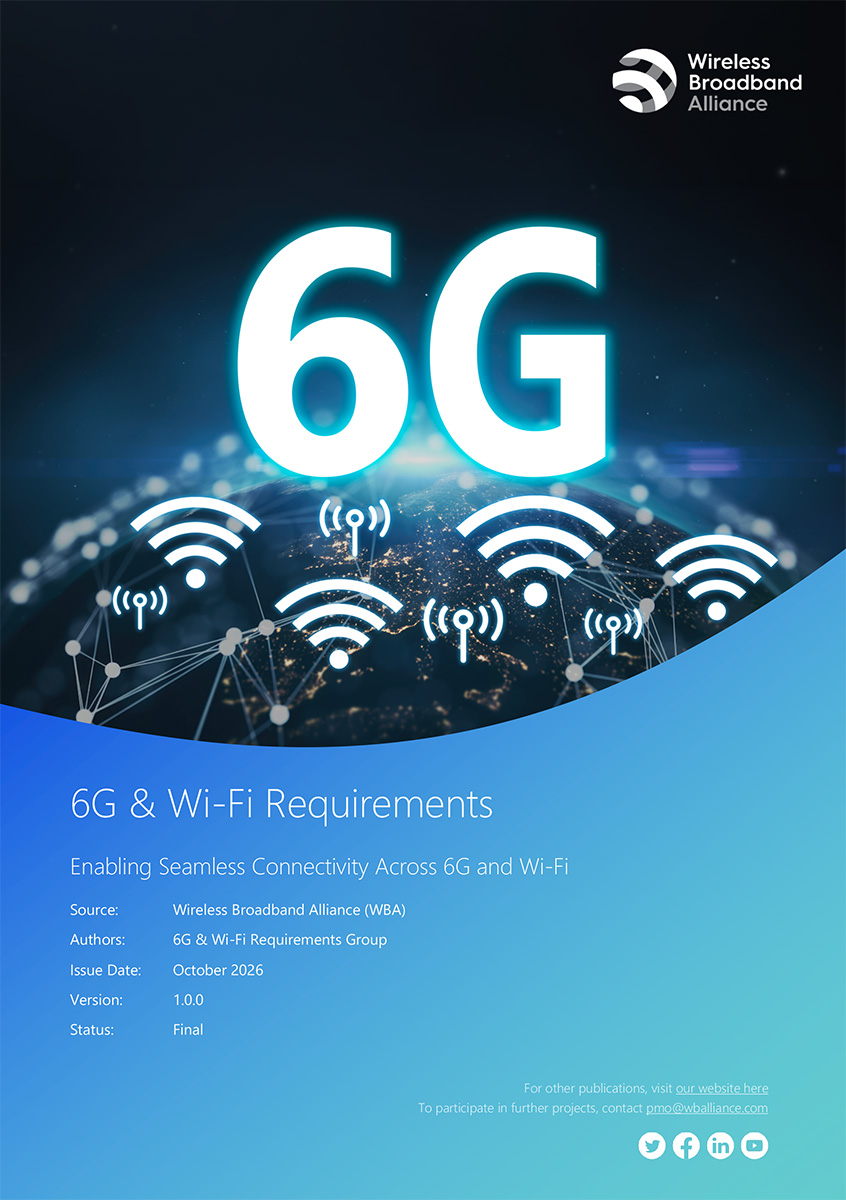
As the industry begins shaping 6G, Wi-Fi needs to be considered as part of the future connectivity framework from the outset—not added later. With Wi-Fi playing a critical role in indoor connectivity, future convergence needs to support different network ownership and deployment models rather than depend on a single cellular-centric architecture.
WBA’s new report, 6G & Wi-Fi Requirements, draws on more than two decades of Wi-Fi and cellular convergence to identify the challenges that have limited wider adoption. It sets out a more flexible, modular and access-agnostic approach for the 6G era, reflecting how networks are deployed and operated in the real world.
The report defines 50 requirements covering interoperability, authentication, security, AI-enabled decision-making, QoS, mobility, energy efficiency and sensing. Together, they provide a practical benchmark to help guide future 6G architecture and standards development.
OpenRoaming® for IoT: Advancing Secure, Zero-Touch Device Onboarding
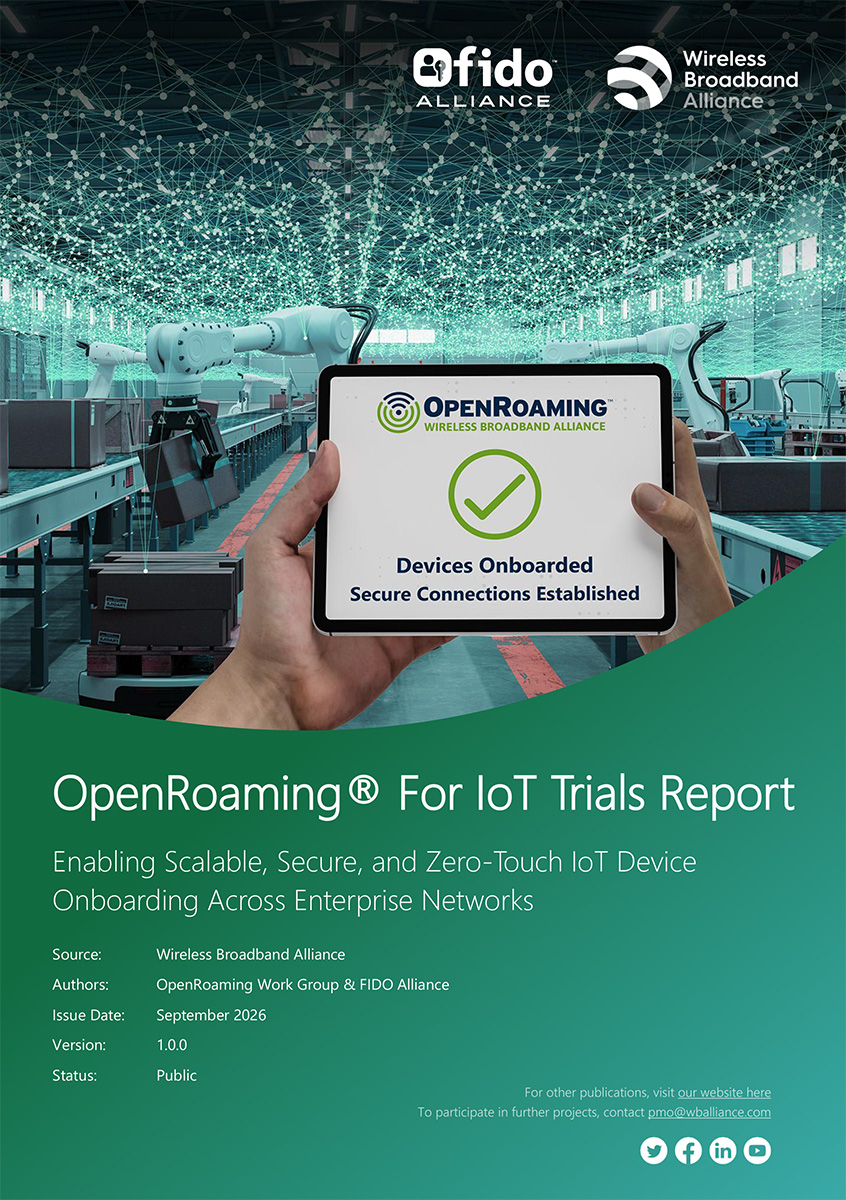
As IoT and edge deployments scale, securely bringing large numbers of devices online remains complex and resource intensive. The OpenRoaming® for IoT Trials Report, developed by the Wireless Broadband Alliance with the FIDO Alliance, demonstrates a standards-based approach to simplify this process.
By combining OpenRoaming, Passpoint® and FIDO Device Onboard (FDO), the trial validated that factory-provisioned devices can automatically connect to an OpenRoaming network at first power-on and begin secure ownership transfer and onboarding without manual Wi-Fi configuration.

Access Network Metrics – Phase 3
The Access Network Metrics Phase 3 Report demonstrates how Access Network Metrics (ANM) move from defined frameworks and transmission models into real-world, production-scale deployment and validation.
Through a large-scale industry collaboration across the WBA membership, the Access Network Metrics production proof-of-concept trial was deployed across 17,000+ access points and supported 350,000+ daily active users, providing the first large-scale evidence of how Wi-Fi quality metrics can directly improve operational and roaming decisions.
This phase with trials shows how quality data becomes actionable intelligence, enabling operators to make smarter decisions on offload, roaming, and network investment based on real performance signals rather than assumptions.
What You’ll Learn
- How ANM was deployed across large-scale production networks
- Real-world use cases for Wi-Fi offload optimization
- How operators can improve authorization decisions using quality metrics
- Methods for identifying underperforming access points
- Best practices for operationalizing network quality data
- Lessons learned from live deployments
Shows how operators can:
- Improved Wi-Fi offload decisions
- Better subscriber experiences
- Data-driven network optimization
- More efficient maintenance and operational investments
- Greater visibility and control across roaming ecosystems

Enterprise Security for Converged Private 5G and Wi-Fi Networks
The WBA Enterprise Security for Private 5G Networks report provides practical guidance for securing Wi-Fi and Private 5G as a unified enterprise network. It explores how Zero Trust principles, unified identity and policy management, centralized security visibility, network segmentation, and AI/ML-driven analytics can help enterprises detect threats, strengthen resilience and protect critical IT and operational technology environments.
Passpoint Profile Standardization Framework
As Passpoint adoption continues to grow across public Wi-Fi, OpenRoaming, enterprise, and service provider networks, inconsistencies in profile provisioning, management, and user experience have emerged across devices and operating systems.
Passpoint has transformed how users connect securely and automatically to Wi-Fi networks. However, fragmented implementations, proprietary profile formats, and limited visibility into profile management continue to create challenges for operators, service providers, and users.
The WBA Passpoint Profile Standardization Framework provides industry-driven recommendations to modernize Passpoint profile structures, improve interoperability, simplify deployment, and give users greater visibility and control over their Wi-Fi experiences.
This report outlines practical recommendations to:
- Standardize Passpoint profile structures across platforms
- Reduce complexity in profile provisioning and deployment
- Improve interoperability between devices, operating systems, and service providers
- Enhance transparency and user control over installed profiles
- Simplify troubleshooting and reduce operational support costs
- Enable future use cases including OpenRoaming, identity-based services, and emergency connectivity

Wi-Fi Monetization & Business Models Report
The Wi-Fi Monetization & Business Models report outlines how Wi-Fi has evolved from a basic connectivity layer into a strategic platform for generating diversified and sustainable revenue. It emphasizes that true monetization extends beyond selling hardware or access, focusing instead on value-added services such as managed connectivity, analytics, advertising, and IoT integration.
Wi-Fi HaLow for IoT Japan Field Trials Report
Building on the successful North American Phase 2 Field Trials, the “Wi-Fi HaLow for IoT: Japan Field Trials Report” marks the completion of Phase 3 trials, validating IEEE 802.11ah Wi-Fi HaLow as a scalable, long-range, and power-efficient connectivity solution for real-world IoT environments.

Wi-Fi Security Guidelines
The WBA’s Wi-Fi Security Guidelines define the global framework for securing modern Wi-Fi networks. Built on OpenRoaming™ and Passpoint®, the report outlines clear, practical best practices for authentication, encryption, identity privacy, credential protection, and network integrity. It also details essential measures for physical and backhaul security, Layer-2 protection, RadSec adoption, and readiness for post-quantum cryptography.
This report is the industry benchmark for building secure, seamless, and interoperable Wi-Fi infrastructures. Designed for operators, enterprises, identity providers, technology vendors, and IoT solution providers, these guidelines strengthen interoperability, protect user privacy, and deliver carrier-grade security across public, enterprise, IoT, and roaming environments.
Wi-Fi Security – General Audience FAQ
The WBA hascreated a Wi-Fi Security FAQ alongside the new guidelines. It gives users, enterprises, and network operators a clear and accessible understanding of modern Wi-Fi security.